reflex-vty: Reflex FRP host and widgets for VTY applications
Build terminal applications using functional reactive programming (FRP) with Reflex FRP (https://reflex-frp.org).
.

[Skip to Readme]

Modules
[Index] [Quick Jump]
Flags
Manual Flags
| Name | Description | Default |
|---|---|---|
| leaktest | Build the space-leak profiling repro (src-bin/leaktest.hs) | Disabled |
Use -f <flag> to enable a flag, or -f -<flag> to disable that flag. More info
Downloads
- reflex-vty-1.0.0.0.tar.gz [browse] (Cabal source package)
- Package description (revised from the package)
Note: This package has metadata revisions in the cabal description newer than included in the tarball. To unpack the package including the revisions, use 'cabal get'.
Maintainer's Corner
For package maintainers and hackage trustees
Candidates
| Versions [RSS] | 0.1.0.0, 0.1.1.0, 0.1.1.1, 0.1.2.0, 0.1.2.1, 0.1.3.0, 0.1.4.0, 0.1.4.1, 0.1.4.2, 0.2.0.0, 0.2.0.1, 0.3.0.0, 0.3.1.0, 0.3.1.1, 0.4.0.0, 0.4.1.0, 0.4.1.1, 0.5.0.0, 0.5.1.0, 0.5.2.0, 0.5.2.1, 0.6.0.0, 0.6.1.0, 0.6.1.1, 0.6.2.0, 0.6.2.1, 1.0.0.0, 1.0.0.1, 1.1.0.0 |
|---|---|
| Change log | ChangeLog.md |
| Dependencies | async (>=2.2.6 && <2.3), base (>=4.10.0 && <4.22), bimap (>=0.3.3 && <0.6), bytestring (>=0.12.1 && <0.13), containers (>=0.5.0 && <0.8), data-default (>=0.7.1 && <0.9), dependent-map (>=0.4 && <0.5), dependent-sum (>=0.7 && <0.8), exception-transformers (>=0.4.0 && <0.5), exceptions (>=0.10 && <0.11), mmorph (>=1.1 && <1.3), mtl (>=2.2.2 && <2.4), ordered-containers (>=0.2.2 && <0.3), primitive (>=0.6.3 && <0.10), ref-tf (>=0.4.0 && <0.6), reflex (>=0.9.2 && <1), reflex-vty, stm (>=2.4 && <2.6), text (>=1.2.3 && <2.2), time (>=1.8.0 && <1.15), transformers (>=0.5.5 && <0.7), unix (>=2.7 && <2.10), vty (>=6.0 && <6.5), vty-crossplatform (>=0.1 && <0.5) [details] |
| Tested with | ghc ==9.8.4 || ==9.10.1 || ==9.12.2 |
| License | BSD-3-Clause |
| Copyright | 2020 Obsidian Systems LLC |
| Author | Obsidian Systems LLC |
| Maintainer | maintainer@obsidian.systems |
| Uploaded | by abrar at 2026-06-25T12:24:50Z |
| Revised | Revision 1 made by abrar at 2026-06-26T11:01:58Z |
| Category | FRP |
| Source repo | head: git clone https://github.com/reflex-frp/reflex-vty |
| Distributions | Stackage:1.1.0.0 |
| Reverse Dependencies | 2 direct, 0 indirect [details] |
| Executables | leaktest, example |
| Downloads | 4850 total (78 in the last 30 days) |
| Rating | 2.0 (votes: 1) [estimated by Bayesian average] |
| Your Rating | |
| Status | Docs uploaded by user Build status unknown [no reports yet] |
Readme for reflex-vty-1.0.0.0
[back to package description]reflex-vty
Build terminal user interfaces with functional reactive programming.
reflex-vty provides a Reflex FRP host and a library of reactive widgets for Vty terminal applications: layout, text input and editing, boxes, scrolling, mouse support, focus management, and theming.





A minimal app
{-# LANGUAGE OverloadedStrings #-}
module Main where

import Reflex.Vty

main :: IO ()
main = mainWidget def $ do
  text "Hello, reflex-vty! Press Ctrl+C to quit."
  ctrlc
mainWidget takes a VtyAppConfig (def for the defaults) and runs a widget until the Event t () it returns fires. Here that is ctrlc, which fires when the user presses Ctrl+C. Docs are available on Hackage.
Features
- Layout: arrange widgets into rows and columns (
tile/grout) with fixed or proportional (stretch) size constraints. - Focus: tab-cycling focus management across the focusable widgets in a layout (
tabNavigation). - Text: word-wrapped text display, rich text with per-span attributes, and single- or multi-line text input backed by a zipper that handles wide characters, tabs, and wrapping.
- Inputs: clickable buttons, hyperlinks, and checkboxes.
- Boxes: single, thick, double, rounded, ASCII, inner-half, and outer-half border styles, with optional titles and horizontal rules.
- Scrolling: scrollable containers with programmatic scrolling, auto-scroll-to-bottom mode, and a visual scrollbar with four visibility modes (always, thumb-only, while-scrolling, hidden).
- Split panes: fixed horizontal and vertical splits, plus a mouse-draggable splitter you can resize at runtime (
splitVDrag). - Mouse: button clicks, drags (with from/to/button/modifier tracking), scroll-wheel events, and last-known mouse-position tracking.
- Keyboard: individual key and key-combo events, plus input filtering.
- Runtime: alternate-screen mode, terminal cursor control (shape, visibility, and position), bracketed paste, terminal focus tracking, resize, and POSIX signal handling.
- Theming: a
Themerecord with presets (default, dark, charm, dracula, nord, zenburn, gruvbox). Widgets inherit the ambient theme and can override locally. - Declarative styling: Lip Gloss-inspired
Styletype with foreground/background colors, text attributes (bold/italic/underline/etc.), padding, margin, borders with per-side colors, width/height constraints, alignment, text transforms, tab expansion, inline mode, whitespace coloring, and border presets. - Color:
RGBcolor type, operations (darken,lighten,complementary,mix,alpha), and gradients (Gradient1D,Gradient2D). - Compositing:
Reflex.Vty.Canvasmodule with per-cell transparency for overlays and layered rendering. - Image composition:
joinHorizontal/joinVertical/placeutilities for composing rendered images. - Color profiles: automatic terminal color-capability detection (
TrueColor/Ansi256/Ansi16/Ascii/NoTTY) with downsampling.
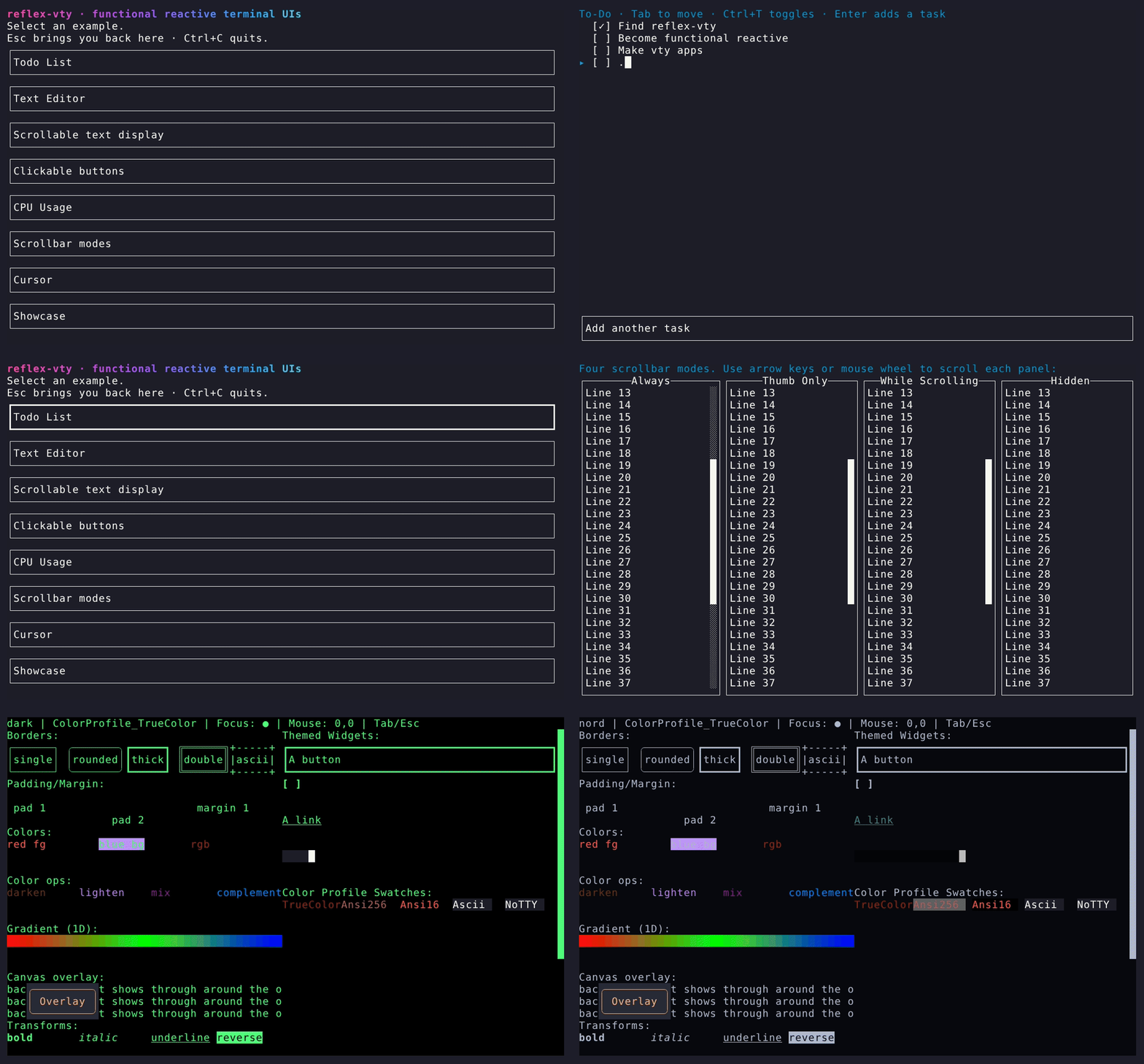
Run the bundled demo with cabal run example to see many of these in action: a text editor, a to-do list, scrollable text, clickable buttons, a live CPU-usage display with a true-color gradient bar, a scrollbar-modes demo, a terminal-cursor demo, and a little styling showcase featuring gradients, color operations, a canvas overlay, border presets, theming, and color-profile downsampling.
Feature requests, pull requests, and other feedback are welcome and appreciated (see the contribution guide). This library is still experimental, so big changes are possible.
How to Build
With reflex-platform
Enter a nix-shell for the project:
git clone https://github.com/reflex-frp/reflex-vty.git
cd reflex-vty
nix-shell
From within the nix-shell you can:
- Run the example:
cabal run example - Load the library in the repl:
cabal repl reflex-vty - Build the example executable:
cabal build example - Build the docs:
cabal haddock - Run ghcid for immediate compiler feedback when you save a .hs file:
ghcid -c "cabal repl library:reflex-vty executable:example test:reflex-vty-test --ghc-options=-Wall" -o ghcid-output.txt - etc.
Selecting a compiler
nix-shell defaults to GHC 9.8. The other compilers defined in release.nix are ghc94, ghc96, and ghc98. To enter a shell with one of them, pass it as the compiler argument:
nix-shell --argstr compiler ghc96
If you were previously building with a different compiler, you may need to run cabal clean first.
With cabal
Please see the tested-with field of the cabal file for known-compatible versions of GHC.
From the reflex-vty project directory:
# nix-shell -p cabal-install binutils icu # for nix users
cabal build          # to build the library, example, and test suite
cabal repl           # to enter a multi-repl covering all components
cabal repl example   # to enter a repl for the example executable only
About Obsidian Systems
reflex-vty is built and maintained by Obsidian Systems. We provide frontier engineering for high-assurance systems: we build production software in Haskell and Nix, and we're long-time stewards of open-source tooling like Obelisk, Reflex, and nix-thunk.
If you're working with Reflex, terminal or web UIs in Haskell, or Nix and want a partner to help design, build, or ship it, we'd love to hear from you.
- Website: https://obsidian.systems
- Blog: https://blog.obsidian.systems
- GitHub: https://github.com/obsidiansystems
License
reflex-vty is released under the BSD-3-Clause License, © 2018 Obsidian Systems LLC.