| Copyright | (c) Ross Paterson 2011 |
|---|---|
| License | BSD-style (see the file LICENSE) |
| Maintainer | R.Paterson@city.ac.uk |
| Stability | provisional |
| Portability | portable |
| Safe Haskell | None |
| Language | Haskell2010 |
Data.YAP.Algebra
Description
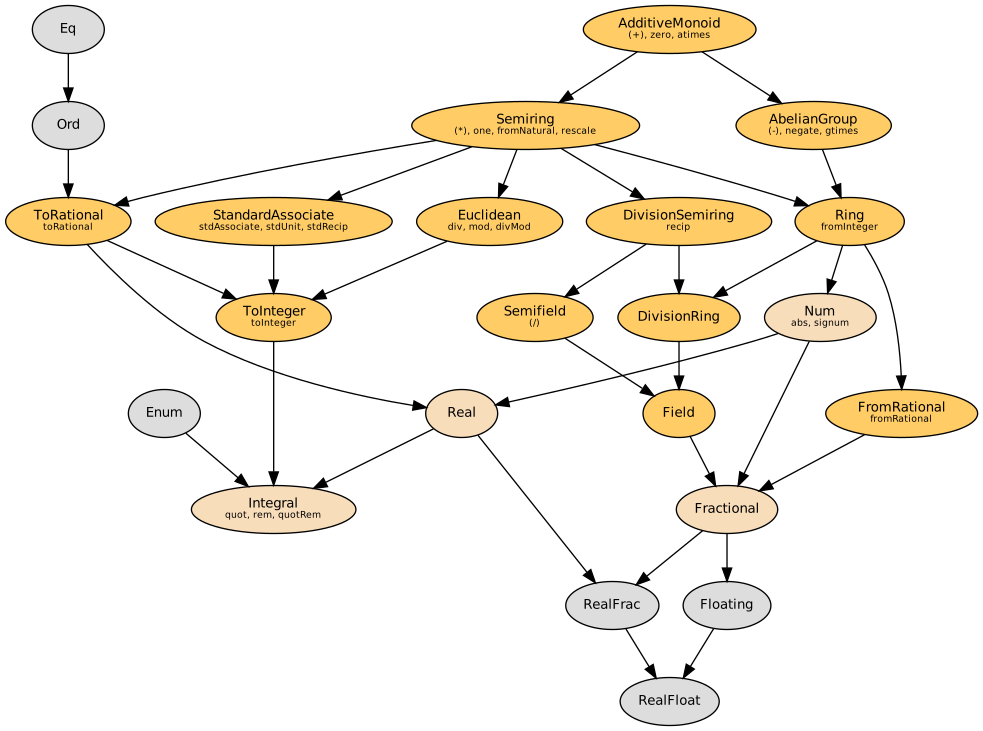
Classes corresponding to common structures from abstract algebra, defined as superclasses of the Haskell 2010 numeric classes, yielding the following class hierarchy (grey classes are unchanged):
Synopsis
- class AdditiveMonoid a where
- atimesIdempotent :: (ToInteger b, AdditiveMonoid a) => b -> a -> a
- timesCancelling :: (ToInteger a, AdditiveMonoid b) => a -> b -> b
- class AdditiveMonoid a => AbelianGroup a where
- (-) :: a -> a -> a
- negate :: a -> a
- gtimes :: (AbelianGroup b, ToInteger b) => b -> a -> a
- subtract :: AbelianGroup a => a -> a -> a
- gtimesIdempotent :: (ToInteger b, AbelianGroup a) => b -> a -> a
- class AdditiveMonoid a => Semiring a where
- (*) :: a -> a -> a
- one :: a
- fromNatural :: Natural -> a
- rescale :: a -> a -> (a, a, a -> a)
- class (AbelianGroup a, Semiring a) => Ring a where
- fromInteger :: Integer -> a
- class Semiring a => StandardAssociate a where
- stdAssociate :: a -> a
- stdUnit :: a -> a
- stdRecip :: a -> a
- class Semiring a => Euclidean a where
- div :: a -> a -> a
- mod :: a -> a -> a
- divMod :: a -> a -> (a, a)
- euclideanNorm :: a -> Natural
- gcd :: (Eq a, StandardAssociate a, Euclidean a) => a -> a -> a
- lcm :: (Eq a, StandardAssociate a, Euclidean a) => a -> a -> a
- bezout :: (Eq a, AbelianGroup a, StandardAssociate a, Euclidean a) => a -> a -> (a, a)
- extendedEuclid :: (Eq a, AbelianGroup a, StandardAssociate a, Euclidean a) => a -> a -> [(a, a, a, a)]
- class Semiring a => DivisionSemiring a where
- recip :: a -> a
- class DivisionSemiring a => Semifield a where
- (/) :: a -> a -> a
- class (Ring a, DivisionSemiring a) => DivisionRing a
- class (DivisionRing a, Semifield a) => Field a
- class Ring a => FromRational a where
- fromRational :: Rational -> a
- class (Ord a, Semiring a) => ToRational a where
- toRational :: a -> Rational
- class (StandardAssociate a, Euclidean a, ToRational a) => ToInteger a where
- class Semiring a => Differentiable a where
- derivative :: a -> a
- class Differentiable a => Integrable a where
- integral :: a -> a
- class AdditiveFunctor (f :: Type -> Type) where
- mapAdditive :: (AdditiveMonoid a, AdditiveMonoid b) => (a -> b) -> f a -> f b
Addition
class AdditiveMonoid a where Source #
A commutative associative binary operation with an identity.
Rationale:
- This is the common superclass of
AbelianGroupandSemiring. General monoids are also useful, but it is a common expectation that an operation denoted by+is commutative. zerois required because this class is insufficient for integer literals.- Ideally,
0could be defined as equivalent tozero, with other integer literals handled byfromNatural.
Methods
(+) :: a -> a -> a infixl 6 Source #
An associative operation.
The identity of (.+)
atimes :: ToInteger b => b -> a -> a Source #
Sum of n copies of x. n should be non-negative.
Instances
| AdditiveMonoid Integer Source # | |
| AdditiveMonoid Natural Source # | |
| AdditiveMonoid Double Source # | |
| AdditiveMonoid Float Source # | |
| AdditiveMonoid Int Source # | |
| AdditiveMonoid Word Source # | |
| AdditiveMonoid a => AdditiveMonoid (Complex a) Source # | |
| (Eq a, StandardAssociate a, Euclidean a) => AdditiveMonoid (Ratio a) Source # | |
| AdditiveMonoid a => AdditiveMonoid (Product a) Source # | |
| AdditiveMonoid a => AdditiveMonoid (Sum a) Source # | |
| (AdditiveMonoid a, AdditiveMonoid b) => AdditiveMonoid (a, b) Source # | Direct product |
atimesIdempotent :: (ToInteger b, AdditiveMonoid a) => b -> a -> a Source #
Faster implementation of atimes when addition is idempotent.
timesCancelling :: (ToInteger a, AdditiveMonoid b) => a -> b -> b Source #
Subtraction
class AdditiveMonoid a => AbelianGroup a where Source #
An Abelian group has a commutative associative binary operation with an identity and inverses.
Rationale:
Methods
(-) :: a -> a -> a infixl 6 Source #
Subtraction operator.
Inverse for ( (unary negation).+)
gtimes :: (AbelianGroup b, ToInteger b) => b -> a -> a Source #
Sum of n copies of x.
Instances
| AbelianGroup Integer Source # | |
| AbelianGroup Double Source # | |
| AbelianGroup Float Source # | |
| AbelianGroup Int Source # | |
| AbelianGroup Word Source # | |
| AbelianGroup a => AbelianGroup (Complex a) Source # | |
| (Eq a, StandardAssociate a, Euclidean a, Ring a) => AbelianGroup (Ratio a) Source # | |
| AbelianGroup a => AbelianGroup (Product a) Source # | |
| AbelianGroup a => AbelianGroup (Sum a) Source # | |
| (AbelianGroup a, AbelianGroup b) => AbelianGroup (a, b) Source # | Direct product |
subtract :: AbelianGroup a => a -> a -> a Source #
gtimesIdempotent :: (ToInteger b, AbelianGroup a) => b -> a -> a Source #
Faster implementation of gtimes when addition is idempotent.
Multiplication
class AdditiveMonoid a => Semiring a where Source #
A semiring: addition defines a commutative monoid, and multiplication defines a monoid and distributes over addition and zero. Multiplication is not guaranteed to be commutative.
Rationale:
Naturalis the key example of a type with multiplication but not subtraction, but there are many more.oneis required because this class is insufficient for integer literals.- In an ideal world, an integer literal
iwould be treated as equivalent tofromNaturali(. (The lexical syntax already permits only non-negative numbers.)Semiringa) => a rescaleis available here with a trivial default definition so that some operations on complex numbers, whose direct definitions would often overflow onFloatorDoublecomponents, can be defined for other types as well.
Minimal complete definition
(*), (one | fromNatural)
Methods
(*) :: a -> a -> a infixl 7 Source #
An associative operation that distributes over (+).
The identity of (.*)
fromNatural :: Natural -> a Source #
Instances
| Semiring Integer Source # | |
| Semiring Natural Source # | |
| Semiring Double Source # | |
| Semiring Float Source # | |
| Semiring Int Source # | |
| Semiring Word Source # | |
| Ring a => Semiring (Complex a) Source # | |
| (Eq a, StandardAssociate a, Euclidean a) => Semiring (Ratio a) Source # | |
| Semiring a => Semiring (Product a) Source # | |
| Semiring a => Semiring (Sum a) Source # | |
| (Semiring a, Semiring b) => Semiring (a, b) Source # | Direct product |
class (AbelianGroup a, Semiring a) => Ring a where Source #
A ring: addition forms an Abelian group, and multiplication defines a monoid and distributes over addition. Multiplication is not guaranteed to be commutative.
Rationale:
- This is sufficient to define
fromInteger, but often a much more efficient definition is available.
Minimal complete definition
Nothing
Methods
fromInteger :: Integer -> a Source #
Conversion from Integer, the initial ring:
fromInteger is the unique function preserving zero, one,
(, +)( and -)(.*)
An integer literal represents the application of the function
fromInteger to the appropriate value of type Integer,
so such literals have type (.
(Ideally, they would represent an application of Ring a) => afromNatural,
and have type (.)Semiring a) => a
Instances
class Semiring a => StandardAssociate a where Source #
A cancellative commutative semiring with a designated canonical factoring of each value as the product of a unit (invertible value) and an associate.
Rationale:
- This normalization is required so that the results of operations
such as
gcdandlcmcan be uniquely defined. In the original Prelude,absandsignumwere used for this, but they lack coherent definitions on many useful instances. - This class is usually used together with
Euclidean, and generally has matching instances. Merging the two classes would be a possibility. That would allow a default definition ofstdAssociate.
Methods
stdAssociate :: a -> a Source #
A representative associate:
- if
xandyare factors of each other, thenstdAssociatex =stdAssociatey stdAssociate(stdAssociatex) =stdAssociatexstdAssociatezero=zerostdAssociateone=one
For integral types, stdAssociate x
multiplicative inverse of stdUnit x
Instances
| StandardAssociate Integer Source # | Units have absolute value 1. Standard associates are non-negative. |
| StandardAssociate Natural Source # | The only unit is 1. |
| StandardAssociate Int Source # | Units have absolute value 1. Standard associates are non-negative. |
| StandardAssociate Word Source # | The only unit is 1. |
| (Ring a, ToInteger a) => StandardAssociate (Complex a) Source # | Gaussian integers: units have magnitude 1; standard associates are natural numbers or in the positive quadrant. |
Division with remainder
class Semiring a => Euclidean a where Source #
A Euclidean semiring: a commutative semiring with Euclidean division, yielding a quotient and a remainder that is smaller than the divisor in a well-founded ordering. This is sufficient to implement Euclid's algorithm for the greatest common divisor.
Rationale:
- This class, together with
StandardAssociate, is sufficient to definegcd, and thus to define arithmetic operations onRatioa - The uniformity condition is required to make modular arithmetic work.
Non-integer examples include
ComplexInteger - The usual definition of a Euclidean domain assumes a ring, but
division with remainder can be defined in the absence of negation,
e.g. for
Natural.
Minimal complete definition
(divMod | div, mod), euclideanNorm
Methods
div :: a -> a -> a infixl 7 Source #
mod :: a -> a -> a infixl 7 Source #
Remainder of division: for any d that is not zero,
n =
divn d * d +modn dmod(n + a*d) d =modn ddivzerod =zero- either
modn dzerooreuclideanNorm(modn d) <euclideanNormd
For integral types, mod n dd.
divMod :: a -> a -> (a, a) Source #
euclideanNorm :: a -> Natural Source #
A measure of the size of a non-zero value.
This may be undefined on zero.
If the argument is non-zero, the value is positive.
Instances
gcd :: (Eq a, StandardAssociate a, Euclidean a) => a -> a -> a Source #
gcd x yx and y such that
stdAssociate(gcdx y) =gcdx y- any common factor of
xandyis a factor ofgcdx y
lcm :: (Eq a, StandardAssociate a, Euclidean a) => a -> a -> a Source #
lcm x yx and y such that
stdAssociate(lcmx y) =lcmx y- any common multiple of
xandyis a multiple oflcmx y
bezout :: (Eq a, AbelianGroup a, StandardAssociate a, Euclidean a) => a -> a -> (a, a) Source #
bezout x y = (a, b)a*x + b*y =
(Bézout's identity).gcd x y
In particular, if x and y are coprime (i.e. gcd x y == one
bis the multiplicative inverse ofymodulox.ais the multiplicative inverse ofxmoduloy.j*a*x + i*b*yis equivalent toimoduloxand tojmoduloy(Chinese Remainder Theorem).
extendedEuclid :: (Eq a, AbelianGroup a, StandardAssociate a, Euclidean a) => a -> a -> [(a, a, a, a)] Source #
The list of quadruples \((q_i, r_i, s_i, t_i)\) generated by the extended Euclidean algorithm, which is a maximal list satisfying:
- \(r_{i-1} = q_i r_i + r_{i+1}\) with \(r_{i+1}\) smaller than \(r_i\), where \(r_0 = a\) and \(r_1 = b\), and
- \(r_i = s_i a + t_i b\).
The last \(r_i\) in the list is a greatest common divisor of \(a\) and \(b\), so that the second equation above becomes Bézout's identity.
Exact division
class Semiring a => DivisionSemiring a where Source #
A Semiring in which all non-zero elements have multiplicative inverses.
Rationale:
- Quaternions have multiplicative inverses, but do not form a field, because multiplication is not commutative.
- Some semirings, such as the tropical semiring and its dual, support division but not subtraction.
Instances
| DivisionSemiring Double Source # | |
| DivisionSemiring Float Source # | |
| Field a => DivisionSemiring (Complex a) Source # | |
| (Eq a, StandardAssociate a, Euclidean a) => DivisionSemiring (Ratio a) Source # | |
class DivisionSemiring a => Semifield a where Source #
A commutative Semiring in which all non-zero elements have
multiplicative inverses, so that division is uniquely defined.
Rationale:
- Some semirings, such as the tropical semiring and its dual, support division but not subtraction.
Minimal complete definition
Nothing
class (Ring a, DivisionSemiring a) => DivisionRing a Source #
A Ring in which all non-zero elements have multiplicative inverses.
Rationale:
- Quaternions have multiplicative inverses, but multiplication is not commutative, so they do not have a well-defined division operation, and do not form a field.
Instances
| DivisionRing Double Source # | |
Defined in Data.YAP.Algebra.Internal | |
| DivisionRing Float Source # | |
Defined in Data.YAP.Algebra.Internal | |
| Field a => DivisionRing (Complex a) Source # | |
Defined in Data.YAP.Algebra.Internal | |
| (Eq a, StandardAssociate a, Euclidean a, Ring a) => DivisionRing (Ratio a) Source # | |
Defined in Data.YAP.Algebra.Internal | |
class (DivisionRing a, Semifield a) => Field a Source #
A commutative Ring in which all non-zero elements have
multiplicative inverses.
Rationale:
fromRationalneeds to be in an independent class, becauseRationalcannot be embedded in finite fields.- While fields trivially support Euclidean division and standard associates, they are kept apart for backward compatibility.
Instances
| Field Double Source # | |
Defined in Data.YAP.Algebra.Internal | |
| Field Float Source # | |
Defined in Data.YAP.Algebra.Internal | |
| Field a => Field (Complex a) Source # | |
Defined in Data.YAP.Algebra.Internal | |
| (Eq a, StandardAssociate a, Euclidean a, Ring a) => Field (Ratio a) Source # | |
Defined in Data.YAP.Algebra.Internal | |
Embeddings
These classes define one-to-one embeddings. In contrast,
the functions fromNatural and fromInteger (in Semiring and
Ring respectively) are not required to be one-to-one.
class Ring a => FromRational a where Source #
Rings extending Rational.
Such a ring should have characteristic 0, i.e. no sum 1 + ... + 1
should equal zero.
Rationale:
- For
fromRationalto be injective, its domain must be infinite, which naturally excludes finite fields. IndeedRationalis initial in the category of infinite fields. (It's true thatFloatandDoublearen't infinite, but they aren't even additive monoids.) - Conversely, many rings that are not fields support embedding of rationals, e.g. polynomials and matrices.
Methods
fromRational :: Rational -> a Source #
Conversion from a Rational (that is, Ratio Integerzero, one, (, +)( and -)(.
Under the assumption that the ring has characteristic 0, this
implies that *)fromRational is injective.
For an infinite field, fromRational is the unique function
preserving zero, one, (, +)(, -)( and *)(./)
A floating literal stands for an application of fromRational
to a value of type Rational, so such literals have type
(.FromRational a) => a
Instances
| FromRational Double Source # | |
Defined in Data.YAP.Algebra.Internal Methods fromRational :: Rational -> Double Source # | |
| FromRational Float Source # | |
Defined in Data.YAP.Algebra.Internal Methods fromRational :: Rational -> Float Source # | |
| FromRational a => FromRational (Complex a) Source # | |
Defined in Data.YAP.Algebra.Internal Methods fromRational :: Rational -> Complex a Source # | |
| Integral a => FromRational (Ratio a) Source # | |
Defined in Data.YAP.Algebra.Internal Methods fromRational :: Rational -> Ratio a Source # | |
| (FromRational a, FromRational b) => FromRational (a, b) Source # | Direct product |
Defined in Data.YAP.Algebra.Internal Methods fromRational :: Rational -> (a, b) Source # | |
class (Ord a, Semiring a) => ToRational a where Source #
Types that can be faithfully embedded in Rational.
Rationale:
Methods
toRational :: a -> Rational Source #
The rational equivalent of its argument with full precision
Instances
class (StandardAssociate a, Euclidean a, ToRational a) => ToInteger a where Source #
Types representing a contiguous set of integers, including 0, 1 and 2.
Rationale:
Methods
toInteger :: a -> Integer Source #
Conversion to Integer, satisfying
fromInteger(toIntegerx) = x
Differentiation and integration
class Semiring a => Differentiable a where Source #
A differential semiring
Methods
derivative :: a -> a Source #
A monoid homomorphism that satisfies
derivativeone=zeroderivative(a * b) = a*derivativeb +derivativea*b
class Differentiable a => Integrable a where Source #
A differential semiring with anti-differentiation
Methods
A monoid homomorphism that is a pre-inverse of derivative, i.e.
derivative(integrala) = a
Mapping
class AdditiveFunctor (f :: Type -> Type) where Source #
A functor on additive monoids
Methods
mapAdditive :: (AdditiveMonoid a, AdditiveMonoid b) => (a -> b) -> f a -> f b Source #